
NCAA women’s hockey enthusiasts will end a seesaw month of March with a double tablespoon of vinegar following Wednesday’s revelation that North Dakota is promptly abolishing its program. The nation’s No. 4 attendance leader from 2016-17 learned its fate in the wake of the deal that salvaged Team USA’s participation in the IIHF World Championship.
The setback is self-explanatory and does not call for much reaction beyond all of the obvious points. Fans in and around Grand Forks will naturally need time to digest and, if possible, recover from this blow.
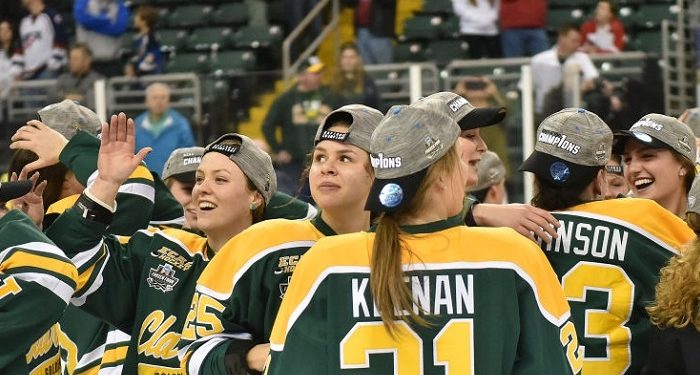
Still, this takes nothing away from the steps the sport took the last time student-athletes engaged in extramural activity earlier this month. Clarkson’s seniors comprise the first graduating class from a non-WCHA school to have won multiple national championships. With their 5-0 sweep through the postseason, the Golden Knights proved they are a Cyclopean force to stay.
Whether they maintain their footing next fall or not, they will doubtlessly encourage their ECAC cohabitants and other established or aspiring Northeast bigwigs to find a new level of power. Meanwhile, the three household names out west are not inclined to recede in the foreseeable future.
Those elements should only combine to bring more breakthroughs in NCAA women’s hockey history a little sooner. As the curtain drops on the 2016-17 season, here are the top five milestones to look for in the future.
An answer to the Ice Breaker
On the men’s side, as College Hockey Inc. articulates it, “The annual Ice Breaker Tournament marks the traditional start to the college hockey season. Celebrating its 20th season in 2016-17, the Ice Breaker brings together four of the nation’s top teams from different conferences.”
Through the showcase’s first 20 iterations, 15 institutions have had a turn hosting. Minnesota-Duluth will become the 16th this autumn.
There is no reason not to introduce an equivalent event in women’s hockey. Why wait until the Frozen Four to capitalize on a geographically diverse assembly of marquee institutions in hopes of amplifying interest in the game?
With four Division I conferences in place, why not select one program from each circuit to kickstart their regular season with a bid for bragging rights? It would give unfamiliar players and places alike a chance to see one another. In some years, it could even take to neutral ice, bringing a smattering of student-athletes home to a locality otherwise bereft of the college game.
A European-born Kazmaier Award winner
After leading the nation with 1.6 points per game, Swiss-born senior Lara Stalder was a can’t-miss contender for the 2017 Patty Kazmaier Award. Had she prevailed in the derby, she would have brought the trophy to a new continent.
Instead, Wisconsin goaltender Ann-Renee Desbiens became the sixth Canadian to garner the title as the nation’s player of the year. Between those six (including two-time winner Jennifer Botterill) plus 13 U.S. natives, each of the first 20 Kazmaiers have gone to a North American.
Riitta Schaublin, Kim Martin, Florence Schelling, Noora Raty (twice) and Stalder have represented the likes of Switzerland, Sweden and Finland among the three finalists. But none ever claimed the laurel.
A national champion from Hockey East or College Hockey America
This is the most obvious omission from the NCAA women’s hockey annals. Its absence glares all the more when you consider how many times Boston College, Boston University and Mercyhurst have come within smelling distance of glory.
But Clarkson’s borderline dynasty, along with the competitive density in the top half of the ECAC this past year, signals a strengthening East Coast.
The HEA is clearly closer to producing an NCAA champion than the CHA at this time, but their ECAC counterparts are surely drawing more eyes to the region. As more top-shelf recruits gravitate there and begin to fill the right slots in the right programs, both conferences will get closer to the crown.
A WCHA-free national final
This is the same basic situation as the last item. To date, each of the first 17 national championship matchups have featured one or more of Minnesota, Minnesota-Duluth and Wisconsin.
But again, Clarkson’s 2014 breakout and 2017 encore have generated a fresher twist. Those Golden Knights teams denied the Gophers a threepeat with wins in the national final and national semifinal, respectively. This year’s installment blanked a Badgers team that looked primed to end what, by its program’s standards, has been an agonizing six-year title drought going on seven.
Heck, BC came within 16.2 seconds of doing the same two nights prior. Had the Eagles held on that much longer and caught the first break in sudden death, we would not be including this item on this list.
A 12-team national tournament bracket
Is it time for the Elite Eight of women’s hockey to expand to a Dandy Dozen? That is a good question with no easy answer.
When you peruse the PairWise rankings from 2016-17, you could credibly argue there were enough qualified teams to fill a field of 12 this year. But were there enough certifiable contenders beyond the top 12? Were there enough of those who could be left genuinely thinking “One more win here, one more point there, and we could have had an at-large resume”?
Colgate, which finished 13th on the leaderboard, fared respectably in an ultracompetitive ECAC. But while five league rivals finished higher than them, the Raiders built their 9-3-2 nonconference record without defeating any Hockey East or WCHA giants. Speaking of which, No. 14 North Dakota went 16-16-6 overall with an aggregate three ties but no wins versus the Badgers, Bulldogs or Gophers.
Come what may, the fact remains that NCAA women’s hockey has only augmented its national tournament bracket once in 17 years. It has been 12 years going on 13 since that field went from four to eight. Advocates for this game have every right to itch for that next signal of greater quality in the college ranks.
Leave a Reply