
With the Nashville Predators’ fan base on full national display for the first time this week, College Hockey Inc. was apt to note the way the relatively new NHL market takes after the college hockey culture. Fittingly enough, this comes at a time when the Stanley Cup Final bears an unprecedented volume of NCAA influence between the boards.
Of the 2017 championship matchup, CHI proclaimed, “The Penguins boast the most former college players of any team in NHL history, with 16 appearing in the playoffs. The Predators counter with only four alums in the lineup, but an environment that resembles an on-campus arena.”
The local press was long making notes of the latter point. As Joe Rexrode of The Tennessean wrote during the second round of the playoffs, “From the 1998 start of the franchise, season-ticket holder Mark Hollingsworth organized chants in Section 303, and they still originate from there.”
Anyone who reads a transcript of the chants or can make them out themselves in real time will realize the Nashville fan’s DNA resembles that of the rabid rooters at Michigan’s Yost Arena. And then there is the customary catfish toss, which evokes the habits of New Hampshire and Nebraska-Omaha loyalists.
Regardless of how long the Nashville flame holds up beyond this spring, other NHL franchises and fan bases would serve themselves well by Xeroxing more pages from the college hockey culture guide. More players are coming out of the NCAA ranks, and most fans of the 23 (soon to be 24) U.S.-based franchises know the college game second-best, if not better than the top pro circuit.
As it enters its second century of operation, the NHL can take one easy step to that effect by bringing historic names back into the limelight. And no, this is not to propose returning to the Adams, Patrick, Norris and Smythe Divisions.
With the impending demise of Detroit’s Joe Louis Arena in favor of Little Caesars Arena, the ship has all but sailed on venues named after people. But there is one other way to name NHL rinks in a person’s honor without robbing the insatiable corporate bug of any sustenance. That is to literally name the rinks — as in the 200-foot long, 85-foot wide surfaces between the boards — after a significant figure in the team’s or locality’s heritage.
As it is, Ohio State’s multi-purpose mansion answers to the full name “Value City Arena at The Jerome Schottenstein Center,” dually dubbed after a sponsor and a donor. Then there are the more intimate NCAA facilities — ones unaffected by the corporate bug — that have a double-scoop of people names on their ice. Case in point: Merrimack’s Lawler Arena at the Volpe Complex.
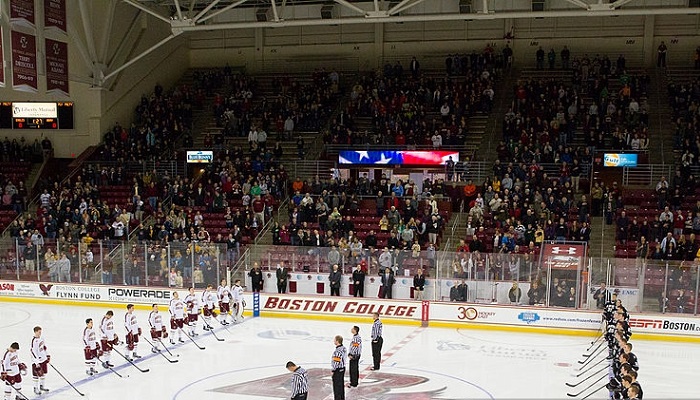
Boston College has one name for its hockey arena, and another name for the rink therein. Why shouldn’t NHL franchises follow that lead? (Photo by Richard T Gagnon/Getty Images)
Boston College boasts perhaps the most notable example in Kelley Rink at Conte Forum. The structure, which also hosts the school’s basketball teams, is named for the late BC alumnus and former longtime Massachusetts Congressman, Silvio Conte. The pond is named in memory of legendary Eagles puck professor John “Snooks” Kelley.
A player in the program’s early days, the latter man was the first college hockey coach to reach 500 career wins, led BC to its first national title in 1949 and took part in the Beanpot’s inception. At crosstown rival Boston University, Jack Parker got the same treatment when Agganis Arena opened in 2005-06.
Montreal’s annals have a comparable figure in Toe Blake, who won a Stanley Cup with the bygone Maroons and two with the Canadiens as a player, then served as the Habs bench boss. His eight championships as a coach stood as an NHL record for three decades. His 500 game victories remain a record for the league’s oldest franchise.
So why not inscribe “Bell Centre” over one half of the center-ice faceoff circle, then “Toe Blake Rink” under the other? For Philadelphia, how does “Ed Snider Rink at the Wells Fargo Center” sound? Edmonton could effortlessly memorialize the Oilers’ and Oil Kings’ original patriarch by rechristening its NHL/WHL venue “Bill Hunter Rink at Rogers Place,” could it not?
Banners bearing the names and numbers of a franchise’s distinguished players have their place on the ceiling. Putting the name of a significant player, coach or builder down where everyone is looking during the game would hammer the history nail with more impact.
Besides the added pinch of mystique and possible temptation for younger fans to learn more history, the mere use of the term “rink” could, in a sense, bring the NHL’s fans closer to the vendor. Just consider the connotations.
The expression normally evokes compact community venues. Yet in its purest meaning, every NHL arena is merely a rink with more seats and more numerous, expansive and expensive surroundings flanking it under the roof.
Nashville’s Bridgestone Arena and its not-so-historic tenant is one anomaly that has instilled enriching college habits without such a lingual maneuver. The antics of the fans in the so-called “non-traditional” market make that case with great facility.
But for the professional game’s other great facilities, a Kelly-at-Conte type of callback could only help. Anything to embrace the elevating influx of U.S. college-educated players in the league and instill a more personal vibe to the fans in connection with their beloved team’s past and present.
Leave a Reply