
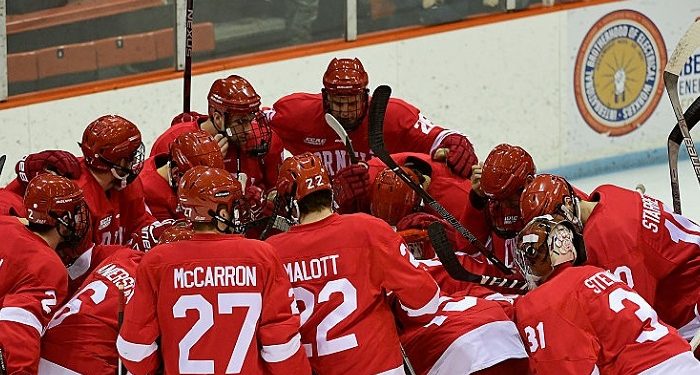
The somber news of Hurricanes Irma and Maria devastating Caribbean nations reverberates around the world more than a month later. In Ithaca, N.Y, in particular, the emotions hit home for members of the Cornell men’s hockey team.
The people of one of those nations, the Dominican Republic, are as good as family to the Big Red. They have been for the last eight years.
“I have seen how little they already have,” senior forward Jared Fiegl told Pucks and Recreation. “To think about them losing the little things they have and then thinking about what you have was kind of a painful thought.
“Talking to Father Ron (Gaesser), luckily afterward, they were mostly inland. It was more just wind damage and nothing too serious in regards to flooding or losing parts of their village. So that was good to hear, but that was definitely unsettling.”
Fiegl’s compassionate response stems from his volunteering on a service trip with his teammates in the summer of 2016. It continued a Cornell hockey tradition of showing that life extends far beyond an ice rink’s dimensions.
Originating in 2009 with the help of coach Mike Schafer and a family friend from the clergy, the trip has seen three renewals in 2012, 2014 and 2016.
“The priest had lived down there, he had worked at St. Catherine’s in Ithaca,” Schafer explained to Pucks and Rec. “My wife had worked for him. He had moved down there when he retired to work there and begin his second career. So we are very close to him. It was natural for us to go down and do some things down there.”

Cornell coach Mike Schafer has seen some of his players become more spiritual upon watching native Dominicans absorb and appreciate the impact of their service. (Photo by Fred Kfoury III/Icon Sportswire via Getty Images) (Photo by Fred Kfoury III/Icon Sportswire via Getty Images)
These four trips were all made possible through a partnership between Cornell hockey and the Portal de Belén Foundation. The foundation supports a number of private day-care organizations and schools in the Dominican Republic, catering to the country’s underprivileged communities.
Fr. Gaesser has been the primary mediator in making these trips possible for the Cornellians. The connection to St. Catherine of Siena in Ithaca has also proved essential.
For Schafer, it has been especially important to return every couple of years with different members of the Cornell program each time.
“It was both for them and even for my own self to get outside my comfort zone,” he said. “The priest always challenged us to do things. He relayed what was going on down there.
“We have so much, and there was something to going down there and seeing the poverty and the kind of impact we could have and just hoping, for our players, what they would get out of it is to see some of the impact they might be able to have in the present. But also when they are 30 or 40, they could embark and do something similar for themselves.”
The impact of the latest 10-day trip left an indelible mark on Fiegl.
“Going to the different schools that Father Ron has helped out through the years was eye-opening for me,” he said. “We not only helped with service projects, but we went and saw different groups of people, whether they were disabled or in a lower-income area.
“It was cool to go around to those schools and interact with the kids. Even driving around and going to these different places was a very humbling experience as well. Within each day, you would have multiple memories of things you would never forget. That was the kind of trip it was.”
Beyond just encountering the people in the Dominican Republic, Fiegl spoke to the tangible impact the team’s service provided. That impact is showcased on a YouTube video found on the hockey program’s channel.
“That was the cool part,” smiled Fiegl. “We pretty much set up the foundation to a church. We worked on the cement walls for the foundation. For that we had to dig out dirt by hand, mostly, and bring buckets of cement in by hand.
“Everything was done by hand. There was no machinery down there, which was different for me. But then we also built latrines, which were a form of a Porta Potty. Most people don’t have a permanent place to go the bathroom down there. We built two latrines down there and then the church foundation.”
While generations of players give way to new blood each time, Schafer has witnessed the evolution of the impact the program has made, even if it is for a week at a time.
“Every day, there is something that occurs,” he said. “There hasn’t been any particular moment. You can see that the kids who love baseball…(commissioner) Rob Manfred from MLB last time, he donated a ton of uniforms and hats. To see those kids get a baseball for the first time or have a glove.
“We see kids get their shoes that have never owned a pair of shoes. To see a woman cry because now they have a meeting place for their community. There has been tons.”
“They are very resilient in the Dominican with regards to how they live and how spiritual they are. They make do with nothing. The spirit of the people, regardless of the hurricane, they will find a way to get through it.” – Cornell hockey coach Mike Schafer
However, one moment did stick out in Schafer’s mind.
“Probably the most meaningful was when we met a young man who we found out that this gentleman had lost his leg and we had found out that he didn’t have any running water. A couple people who didn’t go to church or maybe even believe in God that were there, they went and saw how their $700 would allow an indoor shower for someone that was handicapped, someone who didn’t have running water, they would be able to put running water in the place and allow that to happen.
“The wife of the gentleman in house, she responded to these guys. She talked about how she had been praying for over a year that this was going to come to fruition that this would occur for her and her husband
“To see her put her hands on this big 6-foot-5 hockey player and see the impact that it had on him and his friends at that time changed a little bit of who he was and how he thought about spiritual life. That wasn’t our mission going down, but the instant that it occurred, it was pretty powerful.”
Beyond the encounters the Cornell team had with native Dominicans, the trip also had a welcome benefit for players like Fiegl.
“Getting to know our coaching staff a little bit better was the biggest thing, especially our head coach,” he said “Usually, when we are in hockey season mode, you don’t get that one-on-one time to sit down and talk with him and get to know his family a little bit better, his kids a little bit better.
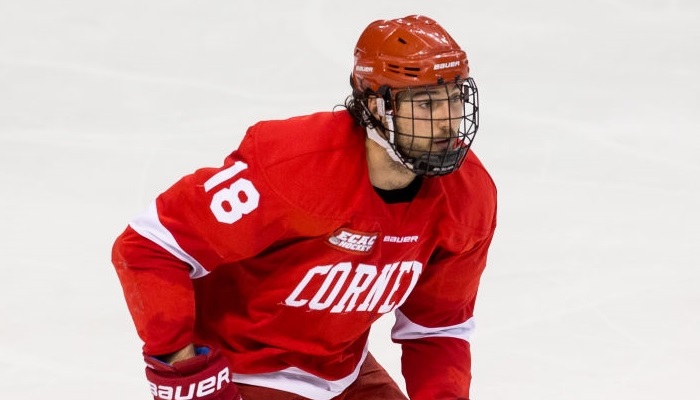
After traveling there the previous summer, Jared Fiegl found it “unsettling” to watch the Dominican Republic brace for catastrophic hurricanes in 2017. (Photo by Richard T Gagnon/Getty Images)
“Regarding the coaching staff, I got to know them a lot better. I went with every classmate except for one that I am currently with and then two classmates below me. Especially the ones below me, I didn’t know as well. I got to know them a lot better over the 10 days we were there.”
Overcoming obstacles together, as a team, facilitated that deepening bond between Fiegl and his teammates.
“The service part was definitely a physical challenge that we had to overcome, especially working in the heat all day,” said Fiegl about the unforeseen challenges. “Not necessarily having access to clean water at some moments or even going three days without showers. Those were physical challenges. We had the language barrier sometimes or transportation issues, just like logistical things that were troubling, but at the end of the day we got it done.”
After speaking with both Fiegl and Schafer, the common theme was that this trip was a humbling and eye-opening experience that allowed both to feel compassion for Caribbean countries recently hit by Hurricanes Irma and Maria.
“They are very resilient in the Dominican with regards to how they live and how spiritual they are,” said Schafer. “They make do with nothing. The spirit of the people, regardless of the hurricane, they will find a way to get through it.
“We built a lot of shelters in the four trips we have gone down. A lot of the schools and churches that we built, they double as a hurricane shelter. It is nice to know that some of the people that we’ve developed relationships with would be a little bit safer because of some of the shelters that were there.”
With the need to keep engaging in service, especially in the wake of these hurricanes, Schafer remains motivated to examine ways that Cornell hockey can return to the Dominican Republic again. He has even thought of reaching out to Cornell hockey alums to see if they were interested in returning.
For players like Fiegl, the choice of whether to return is an easy one.
“If that opportunity comes up, that’s a no-brainer for me,” he said. “It was a great experience for me and once you get a taste of it, you kind of want to go back and do it again.”
Leave a Reply