
The NHL surely crossed its last conceivable boundary when it conducted Game 3 of the 1995 Stanley Cup Final. For the first time, hockey’s definitive league scheduled an official (i.e. non-preseason) contest in summer.
One night after the solstice, the New Jersey Devils cruised to a 5-2 victory and raised a 3-0 upper hand in the series. Two nights later, the desperate Detroit Red Wings briefly led, but New Jersey bolted out of reach late in regulation. Another 5-2 final at Brendan Byrne Arena clinched the Cup.
Barely 14 months passed before more NHL venues hosted meaningful competition during that ostensibly anti-hockey stretch between June 21 and late September. The inaugural World Cup of Hockey replaced the Canada Cup as a recurring international tournament for top-notch professionals.
Because these events occurred in back-to-back summers, they came across as radical developments. But since the 1972 Summit Series pitted Canadian NHL stars against the Soviet Union’s Red Army, an abundance of competitive summer ice hockey games have assumed a prominent place in the sport’s annals.
While the climactic Moscow half of the Summit Series took place after the autumnal equinox, the four games in Canada occurred before. The majority of Canada/World Cup games have happened in August or the first two-thirds of September. And just like 1995, a lockout-shortened 48-game 2013 NHL season pushed the playoff finale back to June 24.
For today’s 2018 summer solstice, here is a look back at the 10 greatest summertime pro or international hockey games. Portions of two Stanley Cup Finals, all three World Cups and all five Canada Cups are eligible. For selectivity’s sake, we limited our pool to playoff-round games.
10. Canada Cup Final: Sept. 18, 1984
Not many box-score details are available on this Canada-Sweden card. But both nations used both of their goalies, and the host’s initial 5-0 runaway threat would turn into its 6-5 escape.
Amidst the early bleeding, and following a 5-2 loss in Game 1, Sweden swapped out Gote Walitalo for Peter Lindmark. Its skaters hit the board before the first intermission, then closed the gap to 6-4 in the middle frame.
By 1:40 of the third, Canada’s Pete Peeters had given way to Reggie Lemelin. In the battle of the backups, Sweden’s strike to close the gap to five proved the period’s only goal. Local favorite Wayne Gretzky thus held up as the tournament’s top scorer (12 points) while Canada clinched at Edmonton’s Northlands Coliseum.
9. Stanley Cup Final, Game 6: June 24, 2013
The last-minute regulation championship-winning goal has happened once in NHL history. And it decided the second of two post-solstice Cup-clinching games.
The visiting Blackhawks trailed Boston twice, falling behind the second time with only 7:49 left in regulation. Then Bryan Bickell buried their second equalizer as an extra attacker with 1:16 remaining.
Dave Bolland followed up by banking home the deciding strike 17 seconds later. Chicago’s 3-2 lead held up for 59 seconds, as its defense withstood the Bruins’ own 6-on-5 push.
8. Canada Cup Final, Game 3: Sept. 15, 1987
The 1984 Canadians never trailed in their championship clincher. The 2013 Blackhawks never trailed by more than one goal in theirs. Conversely, in this winner-take-all tilt at Hamilton’s Copps Coliseum, Canada was confronted with a 3-0 pothole at the eight-minute mark.
Rick Tocchet’s power-play conversion got the home nation on the board 110 seconds later, and Brian Propp made it 3-2. But a last-minute tally restored the Soviets’ two-goal edge before the first intermission.
Canada owned the middle frame, flipping the score to a 5-4 advantage. But Alexander Semak mustered an equalizer for Russia with 7:39 left in the third. That effectively set the stage for Gretzky’s second straight game-clinching assist to Mario Lemieux with 1:26 remaining. The third 6-5 final of the series delivered the trophy to its namesake.
7. World Cup semifinal: Sept. 11, 2004
With the Czech Republic’s Tomas Vokoun taking the brunt of the biscuits, a scoreless draw stood beyond the halfway mark. When Canada finally broke through with two goals in a span of 3:10, the Czechs were swift to respond.
A mere 42 seconds after Lemieux doubled his team’s advantage, Petr Cajanek cut it back to one. At 7:21 of the third period, Martin Havlat tallied the first equalizer on a Czech power play.
Toronto’s Air Canada Centre stirred again when Kris Draper put the hosts ahead, 3-2. But within six seconds, and with 6:07 left in regulation, Patrik Elias issued another rapid retort for the Czechs.
The resultant overtime would last 3:45, at which point Vincent Lecavalier gave the hosts a third and permanent lead. Canada would edge Finland for the title three nights later.
6. World Cup semifinal: Sept. 10, 1996
One week earlier, Canada had bowed to the U.S., 5-3, in a round-robin contest, the first hockey game in Philadelphia’s Corestates Center. But with Sweden facing the Canadians, an otherwise impartial audience cheered Ontario-raised Flyer Eric Lindros.
The main attraction set the tone with his physicality and icebreaker goal. Scott Neidermayer would double the resultant advantage, only to see it halved on Tommy Albelin’s slapper from the center point. Moments later, Peter Forsberg, Philadelphia’s chief sacrifice to acquire Lindros four years earlier, tucked home a rebound.
The ensuing overtime spilled beyond one stanza, as goalies Curtis Joseph and Tommy Salo traded numerous heart-stoppers. Together, they nearly forced a sixth period, until Theo Fleury’s precision solved Salvo with 12.5 seconds left. Parking out in front, Fleury deflected point man Paul Coffey’s blast home, sending Canada to the best-of-three final.
5. Canada Cup semifinal: Sept. 13, 1984
The second semifinal of the third Canada Cup pitted the winners of the first two tournaments. After a scoreless first period and a lead change late in regulation, sudden death would decide who advanced.
Coffey’s setup for John Tonelli broke the ice for Canada at the 7:17 mark of the middle frame. The 1-0 edge held up through intermission, after which the Soviets tallied two unanswered goals.
Defenseman Doug Wilson finally solved Russian netminder Vladimir Myshkin with 6:01 left, reinvigorating the Calgary Saddledome. Almost a full period later, Coffey percolated his team’s second, and permanent, lead of the night. Mike Bossy tipped his shot from the circle-top home for the 3-2 victory.
4. Canada Cup Final, Game 2: Sept. 15, 1976
Two nights after a 6-0 steamroll in Toronto, the Canadians met a decisively more desperate Czech team in Montreal. A quick start gave the inaugural tournament’s namesake nation a 2-0 edge, but a goalie swap at 3:09 of the first period stopped the bleeding.
Replacing Jiri Holocek, goaltender Vladimir Dzurilla minimized an early deficit until a power-play conversion cut it midway through the second. A more tumultuous third period saw Czechoslovakia draw a 2-2 knot, fall behind again, then strike twice in 59 seconds to raise a 4-3 upper hand with four minutes left.
But Bill Barber pulled Canada back even with 2:12 remaining. At 11:33 of the resultant overtime, Darryl Sittler scored to clinch the title for the hosts.
3. World Cup Final, Game 1: Sept. 10, 1996
Opposing the host country at his place of employment, Lindros got Canada on the board first. The non-conflicting Flyer star, Team USA’s John LeClair, then left a rebound for Derian Hatcher to bury early in the middle frame.
Hatcher later spotted America its first lead of the night. That 2-1 edge held up through a chaotic period until Claude Lemieux pulled Canada even with 39 seconds left.
Fleury’s go-ahead strike halfway through the third almost stood as the decider. But the U.S. tallied its own last-minute equalizer via Keith Tkachuk, who forced overtime with 6.3 seconds to spare.
Team USA would ultimately win the bragging rights via two 5-2 victories in Montreal. But even with Tkachuk’s momentous, invigorating equalizer, Game 1 was not its night. Canada’s Steve Yzerman stunned the Philadelphia crowd his sudden-death strike ended the series’ most entertaining back-and-forth contest.
2. Canada Cup Final, Game 1: Sept. 11, 1987
The Soviets trailed in the second minute of the game, then built a 3-1 lead to take into the first intermission. They added a fourth unanswered goal early in the middle frame, and still led by two at the 40-minute mark.
Building on Ray Bourque’s late goal in the previous stanza, the Canadians cut their deficit to 4-3 through Doug Gilmour early in the third. They were still 5:21 away from falling behind in the series when Glenn Anderson pulled them even. Gretzky subsequently put them ahead with 2:59 left in regulation.
But that 5-4 difference lasted 32 seconds, as Viacheslav Bykov buried the night’s third equalizer. That stood long enough to force overtime, and the visitors stunned the Montreal masses at 5:33 via Anatoli Semenov. The third lead change of the night gave the guests a chance to sweep the best-of-three final.
1. Canada Cup Final, Game 2: Sept. 13, 1987
In their effort to avoid a Soviet sweep, the Canadians never trailed, but did surrender four equalizers in regulation. The last of those strikes precipitated a period-and-a-half of overtime, amounting to the longest game in Canada Cup history.
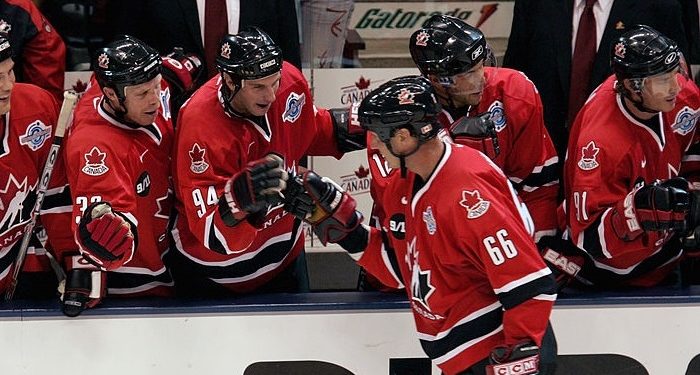
A 1-0 lead in regulation’s opening minute evaporated in the second minute. A 3-1 lead in the 13th minute lasted a full period, only to devolve into a 3-3 deadlock. By the second intermission, Lemieux had spotted his country a 4-3 edge. But that goal and another from No. 66 were each answered in the closing frame.
Finally, at the midway point of double-overtime, Lemieux completed his hat trick and tied the series. His conversion of Gretzky’s pass brought a cathartic finish to a cardic 30 minutes and seven seconds.
Leave a Reply