
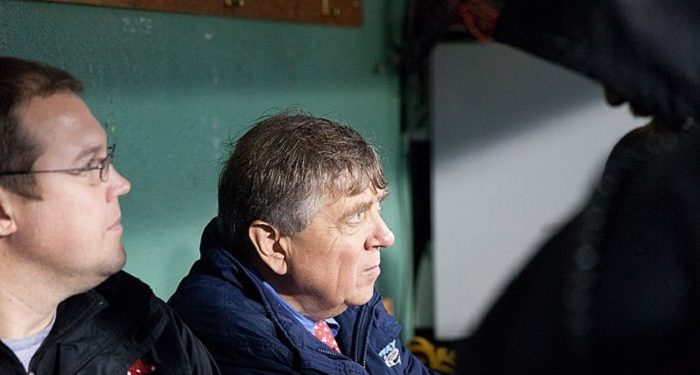
Who better than Joe Bertagna, college hockey’s quintessential establishment figure, to diligently articulate a call for perspective? Anything his sport can do for positive real-world outreach cannot sink in soon enough.
As the current chair of his sport’s rules committee, Bertagna offered one nugget to that effect in a June 20 statement on rule changes. A largely preemptive push for more mindful sportsmanship, he said, is in order.
“We are talking about respect for opponents, respect for officials and respect for the game,” Bertagna said in the NCAA press release. “We live in times where the lack of civility has the potential to reach our game, and we need to prevent that from happening in our sport.”
The last reaction that call warrants is a sea of eye-rolls. The statement came one week after another sporting event on Capitol Hill was marred by a presumed politically charged attack. The buildup to the baseball game in question only garnered national coverage because of the attack. The subsequent choice to carry on with the friendly showdown was the umpteenth cliché-but-true moment we only wish never needed to happen.
It has now been two-and-a-half weeks since Bertagna made his plea to his sport’s community for next season. In that time, we have seen another sports/entertainment entity pawned for a controversial post on social media regarding White House occupants and reporters.
That, too, aroused a largely unified reaction from the same opposing parties. Such a reaction was, again, a breath of fresh air, but did not come from ideal circumstances.
College hockey fans may take comfort in the notion that the hot, poisonous air fueling these fires is securely locked out on game nights. That does not mean Bertagna, his brethren of conference commissioners and associated school administrators can afford a dewdrop of complacency.
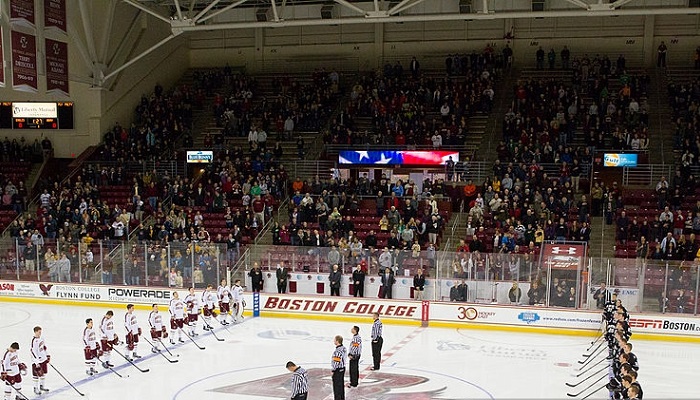
Solidarity and competitive spirit are far from mutually exclusive. In its effort to keep that in mind for its own field, college hockey can direct a statement to broader society. (Photo by Richard T Gagnon/Getty Images)
Even in a setting stripped of sociopolitical lighters, hotheaded habits are hard to cool. The sooner you set your guidelines and instill savory habits to every inch of the arena, the better.
Initiatives of this nature are nothing new for Bertagna, now coming off a combined 35 years in Hockey East and the ECAC. In mid-January of 2009, his conference introduced a poster campaigning for family-conscious fan conduct.
The memorable slogan — “Give your team a cheer but remember who else is here!” — took root and every turnstile and in every public-address announcer’s monologue between warmups and player introductions.
At that time, Bertagna offered in a Hockey East press release, “This is a national and cultural issue. Certain behavior and certain language previously considered distasteful has become commonplace. The overwhelming majority of our fans, including our student population, is absolutely terrific. But we acknowledge that there have been some isolated incidents and there are a few institutionalized cheers at some venues that we would like to see go away. We certainly want our fans to be energized and have fun supporting their teams. But we want all the fans to enjoy the experience, especially families coming to our arenas with young children.”
For the rest of that season and beyond, the amiable admonishment from every P.A. announcer was clockwork. Season-ticket holders and regular beat writers could grow to recite it. “Profanity, racial or sexist comments or other intimidating actions directed at players, coaches, officials, team representatives or other fans will not be tolerated, and are grounds for removal from the arena. We thank you for your cooperation.”
Fast-forward eight-and-a-half years, and Bertagna sees the need to go national with the same message while he can. It matters because, even if game time is a diversion from real life, participants and viewers do not stop being the people they are for those hours.
Moreover, this initiative can help another platitude pick up refreshing merit for a change. If school-based sports are a life-lesson factory, then college hockey can be one venue to set a behavioral bar for more consequential arenas.
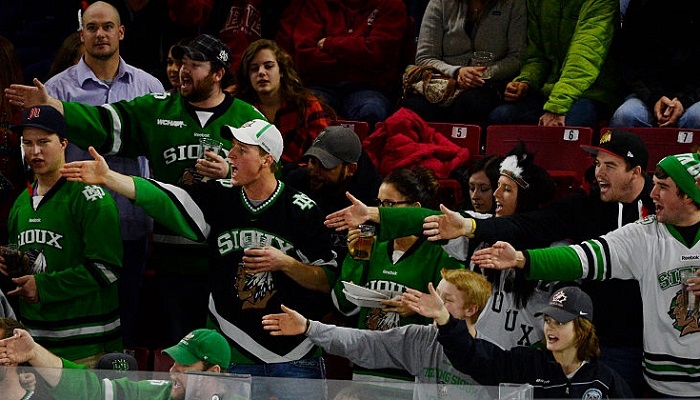
Many college hockey fan bases are renowned for their good-natured jabs in the heat of the game. Nonetheless, Joe Bertagna is wise to take preventive steps that ensure no sociopolitical poisons spill into the arena. (Photo by Andy Cross/The Denver Post via Getty Images)
Per his statement, Bertagna’s motive is to look out for his own field. But he and his colleagues can accomplish more than preserving amicable atmospheres.
Occasional incidents of suspension-worthy on-ice infractions or verbal abuse of officials are bound to break out. But if everyone heeds Bertagna’s entreaty next season, those breakouts will not devolve into acne on college hockey’s façade.
That applies to spectators and their choices of words toward opposing individuals and teams. It applies to what players and coaches say to the press when addressing an unpleasant episode and the rival or officiating parties involved.
It even applies to when, say, struggling teams are starved for good news and, out of frustration, snort at the press for documenting the five Ws of their skid. Just like the chants that warranted the 2008-09 midseason initiative, those cases are hearteningly isolated. But enough sparks from an irascible SID, coach or player can spread the fire to the fan base.
And for what? The vain effort to suppress an inconvenient reality?
There is too much of that unpleasantness churning from corner to corner in walks of life that actually still matter after everyone has dispersed from the rink. Anything Bertagna can say in hopes of stemming — and maybe, as a byproduct, reversing that trend — is welcome.
No one needs to invest their emotions in a sports team. No sports figures need to be held accountable by the media who act as their followers’ eyes and ears.
Conversely, no one can escape the effects of their elected officials’ decisions, and knowledge of those decisions is essential.
If the competitive entertainers in college hockey can present themselves to their reporters and viewers without undue unpleasantness, what excuse would their political counterparts have?
Leave a Reply