
New York hockey has more NCAA Division I men’s and women’s college teams than any other state. It has been that way for years.
Since 1993, only California matches New York’s count of three NHL franchises. Until 2015, the Empire State had the most sizeable AHL membership. The Golden State tied it with five teams, then surpassed it when pro hockey left Albany in 2017.
Nonetheless, that leaves four New York teams in Triple-A plus the ECHL’s Adirondack Thunder. The state has also virtually lost the NWHL’s Metropolitan Riveters to New Jersey, but still definitely has the Buffalo Beauts.
Thursday marks New York’s 230th Statehood Day. It is a perfect time to reflect on the great hockey memories this geographically diverse state has had to itself. The NHL, minor-league and collegiate ranks alike have long been ripe for intrastate intrigue.
In the modern era, the Rangers and Islanders have formed a classic civic saga. When either team meets the Buffalo Sabres, metropolitan and Western New York pride clash.
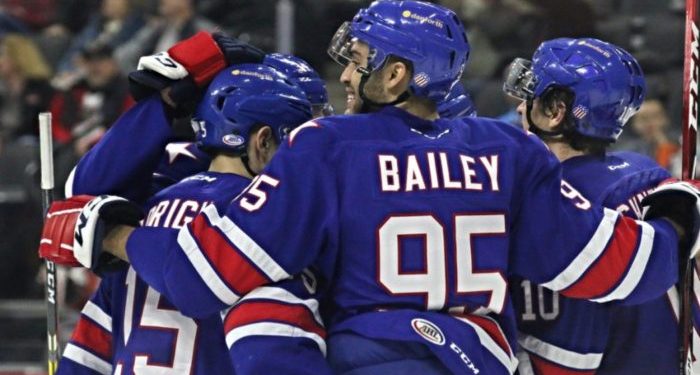
As the state’s sole AHL constant for six-plus decades, the Rochester Americans have variously found feud fodder in Adirondack, Albany/Capital District, Binghamton, Buffalo, Syracuse and Utica.
And since establishing identical memberships of 12 schools in its men’s and women’s leagues, the ECAC has fostered and built on time-honored rivalries. The Clarkson-St. Lawrence, Colgate-Cornell and Rensselaer-Union combinations are all natural local hype generators. But no later than the postseason, any pair of those six teams can percolate adrenaline.
Based on the stakes and closeness of a game or series, here is how New York State’s most memorable pro and college hockey matchups stack up.
10. 1986: Cornell vs. Clarkson (men)
The ECAC men’s conference has seen two Empire State programs meet in 14 of its 57 tournament finals. But only one of those championships required overtime.
The Big Red won that game, 3-2, to claim the 1986 pennant. But not before recovering from Clarkson’s last-second equalizer in the middle frame and a washout on a would-be winning goal in the third.
9. 2010: Cornell vs. Clarkson (women)
On the women’s side, the ECAC has seen five all-New York postseason title matchups. It too boasts one overtime in that category, also a Big Red win over the Golden Knights.
Despite losing, Clarkson made it memorable by making good on a timely timeout. The Knights trailed, 3-0, at 12:38 of the second period, then sacrificed its one allotted breather.
Three unanswered goals amidst a regulation runaway of 35 shots on goal to 17 forced overtime. But Cornell goalie Amanda Mazzotta handled the first three sudden-death stabs before center Kandice Ogilvie gave her team the victory.
8. 1975: Islanders vs. Rangers
We have covered this series on another list, but it works just as well in this context. NHL hockey had arrived on Long Island no later than the 11-second mark of overtime April 11, 1975. J.P. Parise’s goal clinched the deciding Game 3 against the host Rangers in the preliminary round.
The three-year-old Islanders franchise had started their first-ever playoff series by turning a 2-0 deficit into a 3-2 victory at Madison Square Garden. After the Rangers responded with an 8-3 romp at Nassau Coliseum, the Isles needed to rerun their road magic. That bid looked promising when they carried a 3-0 lead into Game 3’s third period.
But the Rangers kept the story compelling, scoring three unanswered goals within the last 16:16. Of course, that merely set up Parise’s heroics, which stands as the picture of the Isles-Rangers rivalry’s maturation.
7. 1938: Americans vs. Rangers
This moment in the NHL’s first Big Apple battle has shown up in this space before.
The final intramural Stanley Cup playoff series logged six overtimes, including four in the deciding third game. In the lone non-OT game, the Rangers avoided elimination after letting a 4-1 lead shrivel to 4-3 late.
Up to that point, the MSG tenant with “road” status had won each game. Facing those disadvantages in Game 3, the New York Americans trailed, 2-0, deep into the third period.
Then Lorne Carr put them on the board with 15:24 remaining. Nels Stewart buried the equalizer with 9:22 to spare, and the equivalent of another full game followed. Finally, Carr struck 40 seconds into the fourth overtime, giving the Amerks the quarterfinal victory.
6. 1984: Islanders vs. Rangers
The Blueshirts’ best chance to break up the Islanders dynasty came in their fourth consecutive postseason meeting. Previously, the “little brother” had swept one best-of-seven series and won the other two in games, all en route to a repeat Stanley Cup.
Now, in a best-of-five first round, the ostensibly drained champions faced elimination on the road. After stealing Game 2 at Nassau Coliseum, the Rangers roared to a 7-2 blowout in the pivotal Game 3. They then took a 1-0 lead into Game 4’s closing stanza.
But then Long Island’s machine regained its gear. Beginning with John Tonelli in the first minute, four unanswered goals forced Game 5 back in Uniondale. There the Rangers took an early lead, then forced overtime on a last-minute 2-2 equalizer.
At 8:56 of sudden death, however, Ken Morrow struck for the Isles, who went on to their fifth straight final. That also ended the last postseason game Morrow’s 1980 Olympic coach, Herb Brooks, oversaw behind the Blueshirts bench.
5. 2007: Sabres vs. Rangers
Second-year Rangers goaltender Henrik Lundqvist was cementing his stardom by the spring of 2007. But a slightly more seasoned Ryan Miller backstopped Buffalo in its follow-up on the Presidents’ Trophy.
All games in this Eastern Conference semifinal except Game 1 were decided by a single goal, two in OT and one in double-OT. After dropping the first two on the road, the Rangers got back into the series via Michal Roszival’s double-OT strike. An identical 2-1 in in regulation sent the series back to Buffalo in a deadlock.
Game 5 was 7.7 seconds away from going to the Manhattanites, seeking their first conference-final berth in 10 years. But Chris Drury, who ironically signed with the Blueshirts as a free agent that summer, spoiled Lundqvist’s shutout and reversed the momentum.
Maxim Afinogenov gave Buffalo the win in the resultant overtime. Two nights later, home ice ceased to hold sway, as the Sabres held on for a back-and-forth 5-4 door-shutter. They were in the third round for the second straight year, and the fourth time in 10 years. Neither New York City team would get that far again until the Rangers in 2012.
4. 1992: Rochester vs. Adirondack
In the early 1990s, the 16-team AHL reserved 12 spots in its playoff bracket. Of the three teams standing after two rounds, the one with the best regular-season record got a final bye. The others squared off in a best-of-three play-in.
In 1992, that matchup featured the league’s two eldest Empire State charters at the time. The Adirondack Red Wings were in their 13th of what would be 20 seasons in Glens Falls, where they had already delivered three Calder Cups. Rochester was in its 36th season, and trying to salve the sting of back-to-back final losses to Springfield.
Holding the lower seed by two points, Adirondack won its lone home game, 3-2. The Americans retorted by the same tally at their place, then hosted the resultant Game 3.
But the Wings flexed their own resilience, claiming a 5-3 victory. From there, they won their fourth and final Cup in seven games over the St. John’s Maple Leafs.
3. 1993: Rochester vs. Binghamton
The regular-season champion Binghamton Rangers and reigning Calder Cup finalist Americans met in a rematch of the 1992 second round. The Amerks had overcome a 3-1 series deficit and won Game 7 at Broome County Veterans Memorial Arena.
Unlike that year, though, whoever emerged in 1993 would not need to go through the subsequent best-of-three play-in. Based on their records, the winner would automatically reach the final if St. John’s lost.
Rochester opened a pair of leads early in the series. But the Rangers claimed Game 2 in overtime — the same night Cape Breton swept St. John’s — and stole Game 4 on the road. They then returned home to take a commanding 3-2 series lead.
On the heels of that 4-2 loss, the Amerks rekindled their cardiac charm, treating their crowd to a 7-5 barnburner in Game 6. Back in Binghamton, they salvaged a 3-2 squeaker and punched their ticket to the final.
2. 1970: Cornell vs. Clarkson (men)
The first all-New York national final was a rematch of Cornell’s 3-2 victory in the preceding ECAC championship. As a bonus, this game took place in Lake Placid. At no time before or since have two intrastate rivals met for the NCAA title at a venue in their state.
The Golden Knights held initial 1-0 and 3-2 leads, with the Big Red taking a brief 2-1 upper hand in between. The squads were deadlocked at both the first and second intermission.
Finally, in the third period, defenseman Dan Lodboa gave Cornell the game’s first two-goal lead with back-to-back tallies. Clarkson cut the deficit, only to watch Lodboa finish his hat trick and cement the 6-4 Big Red victory.
Lodboa would collect most-outstanding-player honors while Clarkson netminder Brett Bullock was named the top goaltender. He had kept the game competitive despite Cornell outshooting the Knights, 46-19.
1. 2018: Clarkson vs. Colgate (women)
This was the first all-Eastern final matchup in NCAA women’s hockey history. One program was looking to become the first non-WCHA team to repeat as national champions. The other was in its first tournament altogether, and trying to become the second non-Midwest school with a single title.
Aiming for their third crown in five years, the Knights had won their quarterfinal and semifinal games in OT. They would need another after 13 third-period shots failed to break a 1-1 deadlock.
After Malia Schneider’s equalizer at 2:27 of the second, the Raiders relied on Julia Vandyk’s valiance in net. Then for nearly eight minutes of sudden-death, the action swayed back and forth.
Finally, as Colgate blueliner Shelby Wood tried to lead a regroup in neutral ice, Clarkson’s Elizabeth Giguere closed in on her. Prying the puck, she took off on a breakaway and deposited the championship clincher.
Leave a Reply