
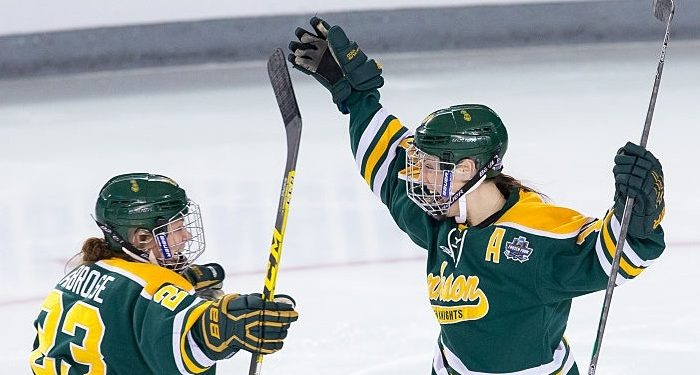
Women’s hockey devotees could have seen something like this coming when the current senior classes were freshmen. Or, at the very least, its eventuality would not have been a far-fetched prediction.
For the first time in the NCAA tournament’s 17-year run, both North Country programs will be in the bracket. Regional rivals Clarkson and St. Lawrence all but confirmed their at-large qualifications by finishing the regular season at second and fourth, respectively, in the PairWise rankings.
The soon-to-be graduating Golden Knights, who in 2014 were part of the first non-WCHA team to win the national crown, will venture in seeking a second ring. Their Saints counterparts will have a chance to derail that dream and claim the ECAC’s second-ever share of NCAA women’s hockey glory.
This after the latter program appeared in the inaugural national final (losing to Minnesota-Duluth), appeared in five of the first seven Women’s Frozen Fours, then went a decade without a return trip. St. Lawrence has not even been to a national quarterfinal since 2012.
Conversely, Clarkson is on track for its fifth consecutive excursion, a string that began one year after the Saints’ dip to first-time futility.
But entering this weekend’s ECAC quarterfinals with the potent circuit’s two clear-cut titans, North Country finally has what the Midwest and Boston’s Commonwealth Avenue have variously enjoyed. Its rumbling rivalry has rolled into the national spotlight for all to see.
“This season has put North Country hockey on the map,” St. Lawrence student-journalist Jack Lyons told Pucks and Recreation. “Both St. Lawrence and Clarkson have very well-established men’s programs, and women’s programs that have also amassed a great deal of success. But when you have both of these teams competing at a really high level at the same time, the eyes of the national media are much more focused on the area and the two schools.”
The locality’s two-faced behemoth is impossible to ignore at this stage. The PairWise pattern has the two highest ECAC seeds disrupting an otherwise all-WCHA top five. The three programs boasting multiple NCAA championship banners (Wisconsin, Minnesota-Duluth and Minnesota) check in at Nos. 1, 3 and 5.
Beyond that, it is Boston College, Robert Morris and a host of other ECAC tenants trickling down to No. 11. Without an automatic bid, as many as three of Clarkson and SLU’s conference cohabitants will likely fall short of a 2017 NCAA passport.
All six potential ECAC ambassadors stayed within single digits in the overall regular-season loss column. With four apiece, only the Knights and the Saints kept their count below five.
In turn, for Northeasterners weary of the WCHA’s endless hegemony (2014 Clarkson triumph notwithstanding), the North Country has replaced the Boston College-Boston University card as the new magnet for attention.
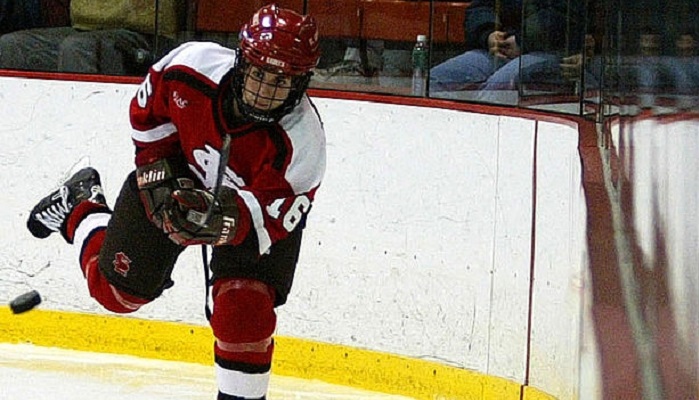
St. Lawrence appeared in five of the first seven Women’s Frozen Fours, but has not reached that stage in 10 years. The Saints are seeking their first NCAA tournament bid in five years. (Photo by Jim Rogash/Getty Images)
“As far as the rivalry goes, it’s intense whether the teams are undefeated or winless,” says Lyons, who has tracked the matchup for multiple print and broadcast outlets. “But when they are competing for the top spot in the ECAC and the chance to host an NCAA regional, it just ups the ante more, and it’s been great for the rivalry.
“At the end of the day, everybody likes watching good hockey, and when two rivals play each other and both teams are good, it makes the rivalry better, for players and fans.”
When Lyons first witnessed the rivalry on an assignment, the Knights were coming off their national championship icebreaker. St. Lawrence was coming off only its second losing season since 1999.
A 19-12-5 run through 2014-15 and a 17-15-6 transcript last season did not suffice in the Saints’ effort to join the locals who had leapfrogged them among the ECAC’s standard-bearers.
That sense of unfinished business was, nonetheless, subtly churning the Saints all the while. Their definitive foes had done what their ancestors could not quite achieve in 2001, and they did it after a 13-year rotation of Bulldogs, Gophers and Badgers as the sport’s monarchs.
“I think (Clarkson’s 2014 victory) was evidence to the entire college hockey world that you didn’t just have to go to Wisconsin or Minnesota to contend for, and win, national championships,” said Lyons. “With that in mind, and perhaps knowing that SLU was the better program when the NCAA tournament began, but Clarkson was the first to win a championship, it is certainly motivation for the team.
“I think the success this year is a manifestation of the philosophy of the team, which is centered around constant positivity. It’s a lot easier to win, and to bounce back from the occasional loss, if you are positive, and I think that’s what we are seeing with this team.”
And now, as their reward, the Saints need only push Yale aside to secure a presumptive journey up the street to Cheel Arena for next weekend’s semifinals. For ECAC enthusiasts, the potentiality of an SLU-Clarkson clash for the conference pennant is akin to when Hockey East advocates got their long-awaited BC-BU final in 2014.
“I’ve seen one playoff series between Clarkson and St. Lawrence, last year on the men’s side in the quarterfinals, and it absolutely lived up to its billing,” Lyons mused. “I would expect nothing less if the women met in the playoffs, especially because it would be in the ECAC tournament championship game.
“Every game is intense, but when you add in the fact that both teams are really skilled, the intensity is even higher, and that makes for really entertaining hockey.”
Leave a Reply