
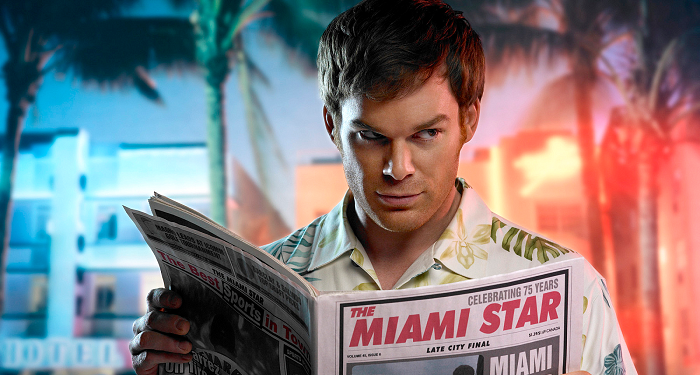
To create a truly successful TV show is a mighty feat. Thousands of scripts are tossed before a network puts a penny toward production. Hundreds of pilots never get picked up. Dozens of shows are canceled every season after just one year on the air.
So when a network gets its hands on a critically- and commercially-successful program, it almost always tries to milk it for all its worth.
Showtime recently announced a celebratory marathon to honor one of its former flagship dramas that suffered such a fate. Dexter, which debuted 10 years ago this fall, was a show that roped us all in with its sharp character study of Miami Metro’s beloved blood spatter analyst by day and code-following killer by night. It was equal parts witty and menacing, and earned every ounce of acclaim it garnered.
Ultimately, like many a Showtime show (sup, Weeds?), it overstayed its welcome, lost its grasp on its main characters, defied logic, broke the sacred code and culminated with one of the most hated final seasons — and episodes — in television history.
It didn’t have to be that way.
While many — myself included — would argue that the first season, pitting Dexter Morgan and (2006 spoiler!) biological brother Brian “Ice Truck Killer” Moser against one another, was the show’s finest outing, Dexter peaked during the fourth season, sparked by John Lithgow’s memorable turn as the “Trinity Killer.”

John Lithgow’s (left) turn as creepy big bad Arthur Mitchell earned him an Emmy.
Following Season 4, showrunner Clyde Phillips, who came aboard early in Season 1, decided to leave the show. Phillips cited family reasons, but it’s easy to infer there was more going on. In addition to outlining the ending he had long envisioned for Dexter (a fate in which the titular character paid the price for his slayings and didn’t, ya know, become a fucking lumberjack), Phillips also talked about how the almighty dollar influences the length of a show’s run during an AMA on Reddit.
“It’s a big financial decision for everyone involved as well, and that has to be honored,” Phillips said. “I would have chosen to end the show when the storytelling well ran dry.”
It dried up pretty quickly after the earth-shattering death of Dexter’s wife, Rita, in the Season 4 finale. At the time, I thought it was a necessary twist. The show couldn’t go on forever with its main focus being Dexter’s attempt to hide his “dark passenger” from his family. Rita died, his stepkids were sent packing, and the show should’ve gotten a nice little refresh.
Instead, the wheels began to fall off one by one.
Dexter started breaking his code. Like, immediately. He killed a guy in a bathroom out of anger in the premiere of Season 5. Rather than being all Solid Snake-like, he began spying on his potential targets — the bad guys who had it coming — in broad freakin’ daylight.
As the storytelling well ran more and more dry, it wasn’t just Dexter that the writers had no idea how to handle. Dexter’s sister, Deb, started having feelings for him. Yeah. Those kinds of feelings. America’s second-favorite blood spatter analyst, Vince Masuka, had a 20-something-year-old daughter show up out of the blue in Season 8, only for that storyline to pretty much vanish halfway through it — but only after he saw her working as a topless waitress. OK!

The writers’ path of destruction spared no characters, including Vince Masuka.
And then there was Hannah. Oh, Hannah. Oh, damn you, Hannah. Dexter related to you and found a connection. But then he wanted to kill you. But then he nailed you in a greenhouse. But then you went to prison. And broke out. And didn’t cut or even dye your hair. Makes sense! And it seemed like you wanted to kill Dexter for a little bit! But no, no. There was love. So much love that he faked his own death and left you to raise his son in South America!
There were bizarre plots, and there were boring ones, too. Like Angel and LaGuerta’s romance, which turned into the most fast forward-worthy segments in the show’s history. They added zilch.
Outside of the occasional shocking moment — Deb finally discovering Dexter’s true, vigilante self; Deb subsequently gunning down LaGuerta — Dexter was in sharp decline from Season 5 onward and never recovered.
It devolved into a laugh-out-loud level of badness in Season 8, making all of the artistic merit it once possessed nearly impossible to recall.
That’s a shame, because Dexter was pretty damn great during the first half of its run. From the powerhouse, award-winning performance of star Michael C. Hall to the memorable big bads, the sorely-missed presence of forever F-bomb-dropping Sgt. Doakes, the shocking kill-room scenes and the hilarious, dry monologues, Dexter was gripping television. Once Scott Buck took over as the showrunner, however, it all went to hell.

Dexter just wasn’t the same without this mother effer.
The fact that the writers dropped the ball so badly is even more perplexing when you look at Buck’s previous efforts as part of the writing team on Hall’s previous project, Six Feet Under. Buck penned “That’s My Dog,” one of the show’s most fascinating episodes in which Hall’s character, David Fisher, is kidnapped at gunpoint, drugged and taken on a terrifying ride through after-hours Los Angeles by a full-fledged lunatic who duped him into “helping him find his lost dog.”
To think that someone capable of crafting something so memorable could oversee Dexter’s tailspin is just… ugh. Nothing summarizes that decline quite like the scene in Season 8 in which Dexter Morgan’s son, Harrison, took on a treadmill, bit the dust and, just before being furiously ejected from the machine, was supplanted by a fully-fucking-grown adult stunt double.

The worst scene in TV history, or the greatest anti-exercise PSA?
It’s also a shame that Hall, who was always on his A-game from start to finish, can now be credited with taking part in what’s widely-considered the greatest series finale of all-time (Six Feet Under) and TV’s most widely-panned one (Dexter).
So go ahead, Showtime. Bust out the champagne. Give a toast to the good ol’ days, when Dexter was on track to go down as one of TV’s all-time greatest shows. But don’t kid yourself, either.
In allowing Dexter to continue to air well past its expiration date, you may have quelled your fears of lost subscribers, but you robbed the show of all its luster, cutting everything that was so wonderful about it up into pieces, dumping them into a black trash bag and sending them sinking to the bottom of the ocean.
That, more than anything that ever took place on screen, is what will always haunt us the most.
Leave a Reply