

Tom Anastos knows as well as anybody that there is only so much one person can do to grow hockey in his home state. His five years and counting as Michigan State’s head coach and preceding tenure as CCHA commissioner have equipped him will all of the necessary knowhow.
Accordingly, when pressed as to his hopes for his Spartans and any instate rivals to rectify the local lack of NCAA women’s hockey in the Division I ranks, he maintained a level head.
“There’s real challenges to try to introduce sports,” Anastos told Pucks and Recreation, adding that he has no desire to put his higher-ups in the East Lansing athletic department “in a tough spot.”
“I think they do a ton for the sports that we offer, and I understand the challenges,” he continued. “When you’re trying to maintain programs, it’s hard to start programs.
“For our particular school, there are varsity programs that could use more economic resources than they have to become more competitive.”
Still, there are ways of delivering aid and building incentive, even in slab-by-slab morsels. On Aug. 16, Anastos and his wife, Lisa, conducted their fifth annual Spartan Hockey Women’s Clinic.
Granted, that event caters to primarily novice enthusiasts, all 18 years of age or older (i.e. no collegians in the making). Nonetheless, it instills the potential for increased hockey interest among Michigan women and girls.
No matter how that interest manifests itself, it could go toward plugging the most embarrassing hole in the NCAA women’s hockey landscape. To date, Michigan’s only involvement there has come via Wayne State, which folded its program in 2011.
There are other regions glaringly devoid of Division I women’s representation. The Buffalo, N.Y., area lost Niagara’s team one year after Wayne State left the party. Meanwhile, neither Colorado College nor Denver have ever fielded a female equivalent for their respective time-honored men’s teams.
But the Western New York institutions (Canisius being the other) do not have the chronicle or prestige of Michigan or MSU. While the Tigers and Pioneers do, they have the added complication of no opponents closer than North Dakota. Although, geographic distance has not stopped Missouri-based Lindenwood from joining a league of five Mid-Atlantic rivals.
Those excuses do not apply in Ann Arbor, where Yost Ice Arena boasts a peerless nine national championship banners and every facility enjoys its hostile receptions of Ohio State visitors.
The University of Michigan nearly established a women’s wing at its barn in 1997. But as the Michigan Daily recalled in 2014, hockey lost a funding derby to the likes of soccer and water polo.
And so, the Wolverines and Spartans stand alone as today’s boys-only Big Ten hockey brands. If they were to rectify that, they could join OSU, Minnesota and Wisconsin in bringing the women’s WCHA’s population to 10 tenants.
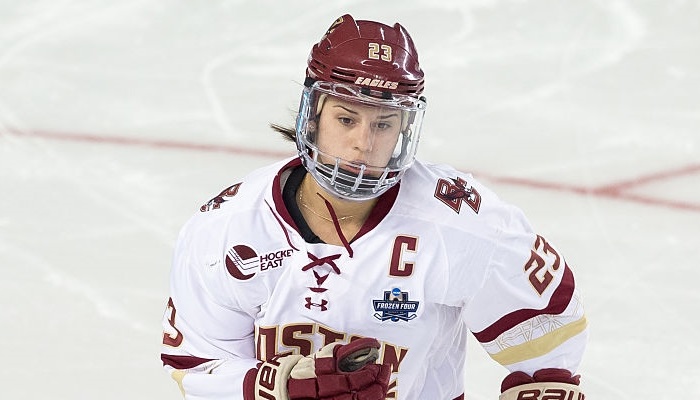
With Boston College senior captain Andie Anastos, like all Michiganders of a Division I caliber, the home state’s loss has been another region’s gain. (Photo by Richard T. Gagnon/Getty Images)
Until 1981, the Wolverine, Spartan, Gopher and Badger men all played under WCHA auspices. Ditto Minnesota-Duluth and North Dakota. Can you imagine if those who lived that era could watch their daughters, nieces and granddaughters reboot those rivalries their own way?
For Anastos, who skated for the Spartans from 1981 to 1985, the next generation could only stay close to home through Division III inlets. That was what one of his daughters, Lauren, did at Adrian College.
Those seeking a slot in the college hockey canopy have needed to seek another hotbed. Andie Anastos did just that, and is now a Boston College teammate of three fellow Michiganders.
The Spartans skipper, who coached his daughters in the Detroit Honeybaked program while heading the CCHA, suggested starting young toward a solution. But he conceded that having a marquee magnet already in place could be a gift to the tepid grassroots as well.
“I think any time that you have opportunities at the highest levels, it spawns interest,” he allowed. “And yet, you have a little bit of the chicken and the egg.
“We have very, very few (girls’) high school teams. There’s not a large quantity of kids playing the sport to create more pressure for the high schools, or even beyond that.
“You could argue that if there’s opportunity at the higher level, oftentimes, that creates more visibility and may encourage more people to participate.”
To those points, one of Honeybaked’s most distinguished alums, two-time U.S. Olympian Kelli Stack, played for the program while living in her native Ohio. Another future Olympian, goaltender Genevieve Lacasse, left Ontario to play for Little Caesar’s in her travel days.
Theoretically, a hypothetical Spartan or Wolverine women’s program could, as a start, likewise supplement itself via out-of-state recruitment. How soon the other prerequisites align — funding and Title IX technicalities chief among them — is another matter, and even the well-versed advocates are strapped for forecasts.
“That’s a tough question for me to answer,” Anastos admitted. “Certainly, you always want to have opportunities, but there’s economic realities you have to deal with, and a variety of other issues.
“Within our state, I don’t know when or if that will ever occur…(but) from the sport’s perspective, you always want to have an opportunity to grow.”
Until then, through little or no fault of its own, Michigan will remain the women’s college hockey canyon between the Northeast and the Central Time Zone.
Leave a Reply