
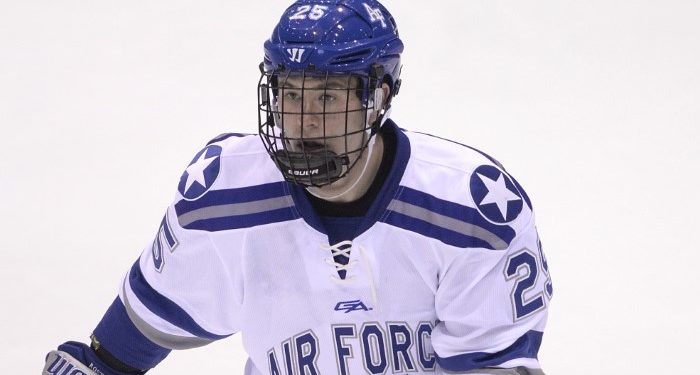
Tyler Rostenkowski could not stay away from service schools, even after spending four years as a junior hockey journeyman.
Like many other hockey players who spend their late teens in the U.S. junior ranks, Rostenkowski hoped to reach the Division I college level. However, having attended Culver Military Academy in his native Indiana for boarding school, he desired more than just hockey for his college experience.
He had to leave the academy after his sophomore year to improve his chances of fulfilling his NCAA aspirations. Rostenkowski’s detour from a mix of studies, sports and military exercise would run from 2009 to 2013, starting with the now-defunct Texas Tornado.
He also appeared for two other teams, the Wenatchee Wild and Amarillo Bulls, during his four seasons in the North American Hockey League. His play in juniors drew the attention of college teams, and he was eventually recruited by Air Force.
When he first went on a visit to the Air Force Academy, the 5-foot-9, 183-pound forward was reminded of his time at Culver. The familiarity and the opportunity to continue his military upbringing played a big role in choosing to attend.
“When I left Culver, I loved it there. I had a full scholarship, and I just kind of missed the opportunity to graduate,” Rostenkowski told Pucks and Recreation. “When I came to the (Air Force) Academy, it essentially was a very big Culver, so I was immediately attracted to the great times I had at Culver, reminiscing about what the future could be and kind of making up for essentially not graduating.
“I was very comfortable with the military uniforms and the certain structure that goes on daily, and the potential to serve my country and give back to people who have given so much to me in my daily life was a massive factor to the reason I came here.”
Life at the Air Force Academy
Life at the AFA is, as one might imagine, different than life at a traditional college. There is no sleeping in and rolling out of bed five minutes before class. One cannot just go to class in shorts and a T-shirt. There is not much time for a late-night Netflix marathon.
College offers many opportunities for students to step up as leaders of various clubs and organizations. These could range from being president of the student government to captaining a club sports team.
As an AFA junior, Rostenkowski demonstrated his leadership as an element leader in his squadron. This allowed him to manage and guide an element of four freshmen and three sophomores to help them transition into their academy lives. He was able to share his experiences and insights from the previous two years, serving as a guide to the group of underclassmen.
This year, as a senior, he is an assistant flight commander, meaning he is the “right-hand man” to the flight commander who controls three elements. In this role, he makes sure daily operations run smoothly and policies are implemented.
Not only are the leadership opportunities different at the Academy, but the daily life is much different as well. In fact, the routine for Rostenkowski is pretty much set in stone from day to day. Of course, it changes from time to time due to having to stay up late to finish a difficult project or homework assignment, but it is otherwise standardized.
“A typical day at the Air Force Academy usually is waking up around 6:30, shave, put your uniform on and then we’ll have an accountability formation in the morning,” he explained. “You’ll have an inspection to see if you’re wearing the correct uniform and shaved and a good haircut. Essentially to make sure everyone is there and accounted for.
“Classes start at 7:30. Most athletes at the academy will have classes in the morning leading up to lunch. We’ll have lunch around 11:30 and then (hockey) practice will probably start around 2:00, video at 2:30 on the ice around 3. Then we probably have a workout afterwards, and then grab some dinner. Then head back up to my room, do my homework and try to get to bed as early as possible.”
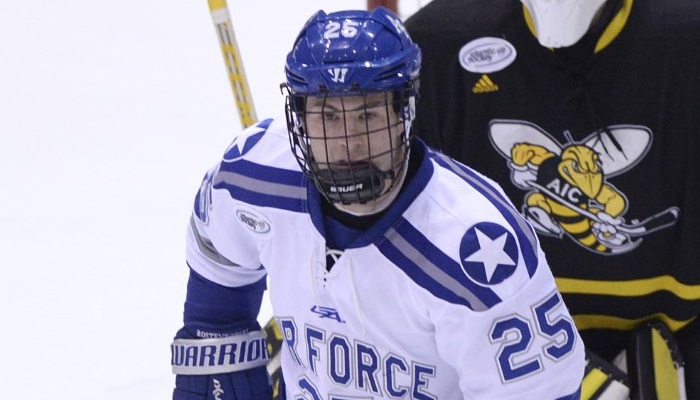
Rostenkowski went from zero games played as a freshman to 14 in 2014-15 to 31 last year. (Photo credit: Team DMI)
‘…one of the greatest and worst experiences…’
All rising juniors at the Academy are assigned to an Air Force base elsewhere in the country over the summer with a small group of others. This allows them to get a feel for what a base is like and to spend some time away from the Colorado Springs campus.
Rostenkowski was randomly selected to go to Shaw Air Force base in South Carolina, along with hockey teammate Johnny Hrabovsky. This allowed him to see the inner workings of the Air Force. On top of that, being assigned to Shaw allowed him to experience elements of the service that are exclusive even by the branch’s standards.
“Shaw Air Force base is pretty awesome because it’s one of three fighter squadrons, I believe, and they have three fighter squadrons of F-16’s,” he said. “I was fortunate enough to get to ride an F-16, and it was one of the greatest and worst experiences of my life.”
While it would initially seem like there would be no negatives in going for a ride in an F-16, it is a shocking experience for someone who has not done so before. The aircraft can reach speeds of 1,500 miles per hour, and during the flight the crew withstands intense G-forces.
“I think I threw up three times during my flight,” he recalled, “but it was an awesome experience pulling G’s and doing some aircraft maneuvering. Not many people get the opportunity to go on a ride with a fighter pilot, so it was pretty awesome.”
That flight experience is one that he will surely never forget. However, the members of the Falcons hockey team take a number of interesting flights throughout the course of the season. For example, after the Atlantic Hockey tournament in Rochester, N.Y., last season, the team got an airlift from the Puerto Rican Air National Guard.
While Rostenkowski was not on that particular flight due to the way the schedule worked out, he has savored other experiences in flying to road games on military aircrafts.
“We get the opportunity to fly on cargo planes, which is obviously a cool experience,” he shared. “We don’t have to wait for security or worry about getting our bags, they’re right on the flight. The C-17’s and the C-5’s are some big aircrafts where you can throw some footballs around and hang out with your teammates. Some planes are a little tighter, but obviously it’s a cool experience nonetheless to be flying with people that you’re soon going to be serving in the Air Force with.”
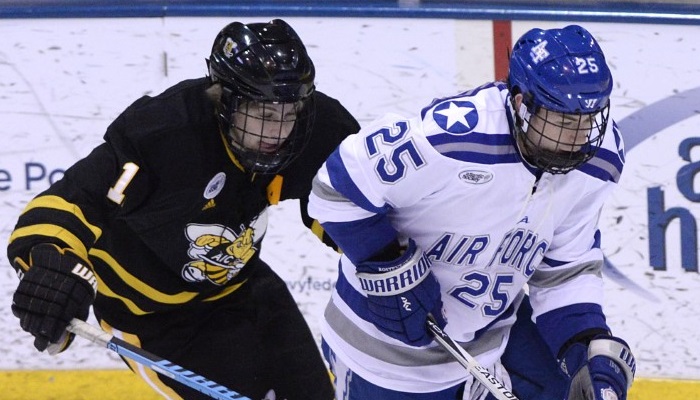
Rostenkowski opted for the No. 25 as a nod to a former teammate whose fight to sustain a roster spot inspired his own. (Photo credit: Team DMI)
‘I thought my only option was to work harder’
While hockey, compared to military training has been more of a constant since his Culver days, Rostenkowski had to prove himself to get a shot at playing with the Falcons. He did not appear in a game as a freshman, and did not even have a stall in the team’s main locker room to begin his sophomore season.
“I thought my only option was to work harder,” he said. “I wanted to make the decision for them as difficult as possible, to the point where they said, ‘We have to play this kid, he’s working too hard, he’s doing too many good things.’ Obviously it wasn’t the easiest thing, but I have a lot to thank my parents, my teammates, friends and family for who were there and understood what was going on.”
This perseverance is something that he takes pride in through all aspects of his life. Rostenkowski was able to help a young Falcons squad advance to the Atlantic Hockey semifinals last season, contributing five goals, including three game-winners.
While he has done a lot to get to this point, he aspires to accomplish more in his senior year.
“I’m the kind of person that’s going to give my best effort and work as hard as possible in anything I do,” he explained. “Obviously I’m beyond grateful to have been given the opportunity to appear in some games and be in the locker room and on the roster my sophomore year. I wasn’t satisfied then. I played more my junior year, and I promise you I’m not satisfied this year and I want more, and I’m not going to stop working until I get it.”
More than just a number
The most influential person in Rostenkowski’s college hockey career was 2014 AFA graduate Mitch Torrel. Rostenkowski explained that Torrel was initially released from the team in his junior year, but invited back later in the season and went on to play his senior year as well.
To Rostenkowski, Torrel’s work ethic through what he endured especially stands out. He is someone who can look back on his career and know that he gave it his all.
Torrel wore No. 26 his first two seasons, but that number was chosen by an incoming freshman when he was released. When he came back onto the team, he chose No. 25.
Rostenkowski was initially set to wear No. 14 as a rookie, but having never appeared in a game that season, the jersey was given away in 2014. When he eventually made the roster his sophomore year, he went with Torrel’s old second-chance digits.
“Mitch had a great senior season and worked hard and was actually named most improved player by his teammates and myself,” he said. “I chose 25 for that reason. Essentially, don’t count me out. I’m going to keep working and prove myself similar to what Mitch did. Obviously, he had a different road to senior year, and my road’s been a little bit different, too.
“The number kind of just reminds me that nothing’s given to me. I’ve got to earn everything I got, and to keep striving. My sophomore year I won most improved as well, I haven’t looked back and I want to keep moving forward.”
Leave a Reply